per unit at 1,000 units — goods, agent fee, freight, US import fees and delivery. Duty is not included; see below.
Basis: Aggregated from 25 current wholesale listings in this category, costed with our standard import model. volume and weight assume a typical export carton for this category, not one supplier's packing list — 56 × 42 × 36 cm, 24 per carton, 14 kg gross, giving 0.00353 CBM and 0.58 kg per unit; your own carton will move the freight line. duty excluded, because the rate depends on how your product classifies — the table below shows what any rate adds. figures as of 1 September 2026. individual figures are not attributable to any one supplier.
What duty adds
We do not publish a single duty rate for this category, because classification depends on the product's construction and materials rather than on what it is called. Rather than print a number that would be wrong for some readers, here is what any given rate does to the figures above.
| Duty rate | Landed per unit | Versus no duty |
|---|---|---|
| No duty | $4.09 | — |
| 5% | $4.26 | +4.1% |
| 12% | $4.49 | +9.8% |
| 25% | $4.93 | +20.4% |
| 37% | $5.33 | +30.1% |
Establishing your own rate is your responsibility as importer rather than your supplier's — our guide to classification sets out how, including requesting a binding ruling if you intend to import repeatedly.
The unit price of an LED desk lamp is the least interesting number in the project. What decides whether the product works commercially is certification, and certification is charged per model, paid up front, and specific to the market you are selling into. A first order that ignores this is not cheap; it is unsellable.
Where the money goes
Two costs dominate and neither scales with quantity the way buyers expect. Testing and certification is a fixed charge per model per market. Tooling, if you want a housing that is not already in the factory's catalogue, is a second fixed charge. Both have to be spread across the order, which is why the first order in this category almost always looks expensive per unit and the second one does not.
The product itself is moderately dense, so freight sits somewhere between the extremes of a storage box and a spanner — present, but not the thing to optimise first.
What drives cost in this category
Market certification
What you need depends on where you sell. North America, the EU, the UK and Japan each have their own regime, and a report for one does not carry over to another.
The driver
The LED driver is where cost is cut most often and where failures originate. A cheap driver produces flicker, poor lifetime and, occasionally, a safety problem.
LED quality and binning
Colour consistency between units comes from binning. Unbinned LEDs mean two lamps from the same carton visibly differ, which generates returns.
Housing tooling
A distinctive shape means a new mould, quoted separately and amortised over the run. Using an existing housing is the single fastest way to make a first order viable.
Minimum order quantities
| Existing model, factory branding removed | Lowest floor, and the only sensible way to test a market. |
| Existing model, your logo and packaging | Modest increase driven by print setup rather than production. |
| Existing housing, your specification of driver and LED | Rises with the component minimums, which are set by the component makers rather than the assembler. |
| New housing tooling | Highest floor, plus mould cost. Settle mould ownership in writing before cutting. |
Where these are made
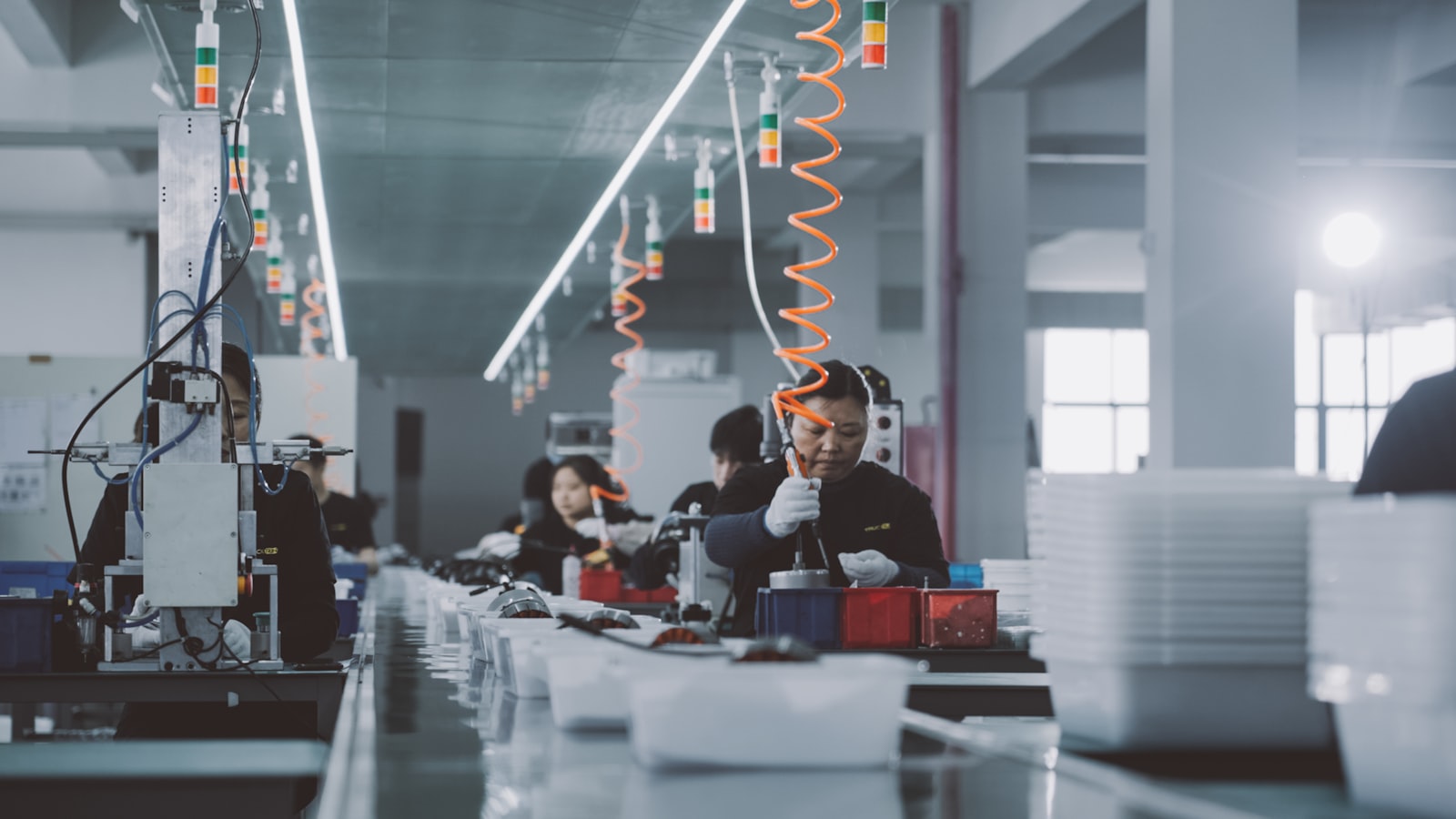
Lighting assembly sits inside the wider Guangdong electronics supply chain, and Shenzhen is the usual entry point because drivers, boards, LEDs and housings are all sourceable within it. As with tools, the company quoting you may be an assembler rather than a component maker — worth knowing before you decide whose test report you are relying on.
What goes wrong
- Certificates that belong to another product. A test report is issued against a specific model and configuration. A report for a similar lamp is not a report for yours.
- Driver substitution after approval. The sample passes, production quietly uses a cheaper driver. This is the single most common failure in the category.
- Overstated lumen and lifetime figures. Frequently copied from the LED datasheet rather than measured on the finished lamp.
- Wrong plug or voltage for the destination. Trivial to get right, expensive to discover in a warehouse.
The defence is a written specification naming the driver and LED by part number, plus inspection that opens units from the production run and checks the components against it. Verifying the supplier and the provenance of their certificates matters more here than in almost any other category.
Certification is the recurring theme across this whole category. See electronics sourcing.